Cinder Block Foundation Repair in Gardner, Kansas

A cinder block foundation wall cracks along its mortar joints, and the shape of those cracks shows which way the wall is moving. Most block walls can be straightened and braced, and we rebuild a section only when it has moved too far to hold.

Before any block wall repair

How Cinder Block Foundation Walls Crack and Bow

A block foundation wall is built from hollow concrete blocks stacked in rows and held together by mortar. The mortar joints are the weakest part of the wall, so that is where it gives way first.

When the soil outside pushes on the wall, the wall tends to bow inward along one long row of mortar.

When the footing under one end settles, the wall cracks in steps that follow the joints down toward that corner.

The hollow blocks also change how water gets in. Water that gets into the wall can run down inside the blocks and come out at the bottom of the wall, down by the floor, sometimes well away from where it got in.

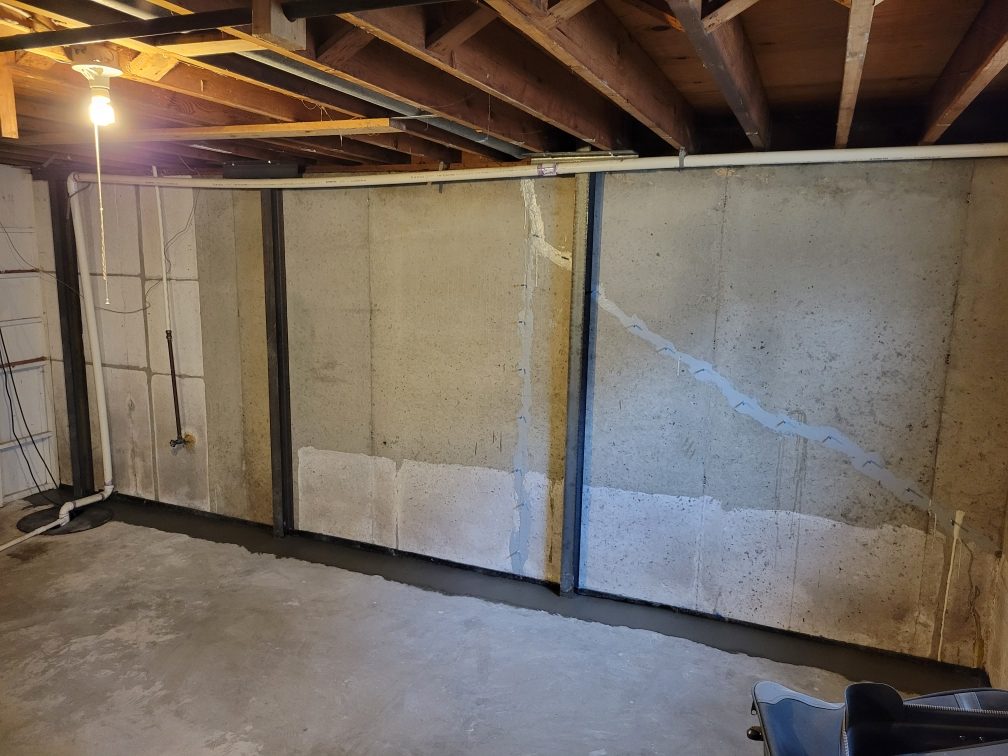
Steel wall restraints installed on a repaired basement wall

Where block walls give way

Signs Your Cinder Block Foundation Wall Is Moving

Grab a flashlight and look at the mortar lines between the blocks, not the blocks themselves.

When a block wall starts to move, the mortar cracks first, long before any block breaks. The shape those cracks make tells you which way the wall is moving, and the cards below show what each shape means.

Stair-Step Cracks in the Mortar Joints

Look for a crack that steps down through the mortar, block by block, like a staircase.

It usually runs toward a corner of the house that has settled. The blocks themselves are often fine, because the mortar between them is what gave way as that corner dropped.

Photo coming soon

One Long Crack Along a Row of Mortar

Some cracks run sideways along a single row of mortar, often about halfway up the wall.

That crack comes from the soil outside pushing on the wall, and it often shows up before the wall starts to bow.

A Block Wall Leaning In at the Middle or Top

Hold a long, straight board or a level flat against the wall, running from the floor up toward the ceiling. If the middle of the wall, or the part up near the ceiling, sits closer to you than the part down by the floor, the wall is bowing inward.

A wall can lean this way for years with only small cracks, so the lean is worth checking even when the cracks look minor.

Photo coming soon

Blocks That Have Slid Out of Line

Run your hand along the lower rows of block. Where one row has slid inward past the row beneath it, you will feel a ledge.

That usually means the soil is pushing low on the wall, and it is one of the main reasons a section of block wall ends up being rebuilt.

Photo coming soon

Dark, Damp Blocks Near the Floor

Check the bottom few rows of block after a rain for dark, damp patches.

Water that gets into a block wall can run down inside the hollow blocks and come out near the floor, even when it got in much higher up.

White, Chalky Crust on the Blocks

Look for a white, powdery crust on the lower blocks, even if the wall is dry today. It is called efflorescence.

Efflorescence is the minerals water leaves behind as it dries, so water has been coming through that part of the wall.

Seeing Stair-Step Cracks or a Block Wall Leaning In?

Call us as soon as you notice cracks or a block wall leaning in. If you can, snap a photo of the wall from a few steps back so the whole thing is in the frame.

The pattern of the cracks across the wall tells us more than a close-up of any one of them.

How we repair block walls

The Cinder Block Wall Repairs We Do

Most block walls that have cracked or bowed can be saved. Rebuilding is for the few that have moved too far to hold, and the inspection tells us which kind of wall you have.

01

Straightening and Bracing a Bowed Block Wall

A block wall bowing in along one row of mortar will keep moving as long as the soil outside keeps pushing on it.

We brace it with steel restraints fastened to the basement floor and the framing above, then push it back out a little at a time. The longer a wall has leaned, the harder it is to get perfectly straight, and we tell you what to expect before we start.

Bowing wall repair

02

Piering Under a Settled Corner

Stair-step cracks running down toward one corner usually mean the footing under that corner has dropped.

We drive steel piers down through the soil beside the footing until they reach bedrock, then attach the top of each pier to the footing so that corner rests on the piers instead of the soil. That stops the settling that was pulling the mortar joints apart.

Foundation piering

03

Keeping Water Out of a Block Wall

Because the blocks are hollow, water that gets into a block wall can travel inside it before it shows up in the basement.

We waterproof block walls from the outside with a membrane, from the inside with drain tile along the base of the wall, or both, depending on where the water is getting in.

Basement waterproofing

04

Rebuilding a Section of Block Wall

Rebuilding is the last option, for a block wall pushed in so far or slid so badly out of line that bracing would not hold it.

We dig the soil away from the outside, take the damaged section down to solid block and rebuild it with new block and mortar. The outside gets waterproofed before the soil goes back against it.

Foundation excavation

Where we work

Serving the Kansas City Metro

We're based in Gardner, and we're a growing company. Right now we're expanding about 45 miles out in every direction, which covers most of the metro on both sides of the state line. Not sure if we make it out your way? Give us a call and ask.

Kansas Service Area
  • Gardner
  • Olathe
  • Overland Park
  • Shawnee
  • Lenexa
  • Leawood
  • Prairie Village
  • Merriam
  • Mission
  • Spring Hill
  • Edgerton
  • De Soto
  • Lawrence
  • Eudora
  • Baldwin City
  • Ottawa
  • Wellsville
  • Paola
  • Louisburg
  • Kansas City
Missouri Service Area
  • Kansas City
  • Belton
  • Grandview
  • Raymore
  • Peculiar
  • Harrisonville
  • Lee's Summit
  • Raytown
  • Independence
  • Blue Springs
Family home in the Kansas City area at dusk

Free estimate

Schedule Your Free Block Foundation Wall Inspection

In the message box, tell us which wall has the cracks, whether they step through the mortar or run straight across, and whether the wall looks like it leans in.

If water comes in at the bottom of that wall, add that too. It often changes what the inspection needs to cover.

Location
Gardner, KS 66030
Hours
Monday to Friday, 8:00 AM to 6:00 PM
Saturday and Sunday, Closed
When's the best time to contact you?

A photo of the crack, wall or wet spot helps us see what is going on before we come out. Up to 3 photos.

Texts & email

Prefer to talk? Call (913) 444-0115 during business hours.

Worth knowing

What We Want Every Homeowner to Know About Cinder Block Foundation Walls

A cracked block wall sounds like bad news, but most of them can be saved. Here is what to know before you assume the worst.

A Block Foundation Is Not Worse Than Poured Concrete

A block wall that is dry and straight is doing its job, whatever it is made of.

Block does crack differently, along the mortar instead of through the concrete, so its cracks look different and we read them differently.

1 of 4